With proper care, quality batteries that are sized correctly for your application will last for years. If abused, an expensive battery bank may last only months. Taking out too much power without recharging is what kills most batteries. Also, batteries that are low will freeze easily, while a fully-charged battery is good to at least 30 below zero.
Battery capacity is measured in ampere-hours (amp-hours). In rough terms, a 100 amp-hour battery can give out 1 amp for 100 hours, or 100 amps for one hour, or 20 amps for 5 hours. However, see the first item below--you would actually never want to use the entire capacity before recharging.
Meters can be as simple as a voltmeter to measure battery bank voltage and an ammeter to show net gain or loss of power, or as complicated as a digital amp/hour meter (highly recommended).
- If possible, never use more than 20% of your battery bank's capacity. If your capacity is 1000 amp-hours, start your back-up generator when the meter shows -200 amp-hours (80% of capacity remaining).
- Never use more than half your battery capacity without recharging.
- If you use 75 to 80% of your capacity without recharging, your batteries WILL be damaged, even if they are "deep-cycle" batteries.
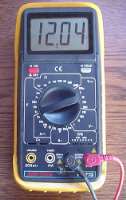
- By Voltage: This method is the least accurate, but requires only a cheap digital voltmeter. It will not work for NiCads or Telephone cells. Analog meters (with a needle) are generally not accurate enough for this.
-
- Wait 2 hours after any charging or discharging to take your measurement (use your disconnect switches to stop
 all charging or discharging if neccessary)
 - Measure DC voltage across the main positive and negative terminals (where the inverter and/or solar panels are connected to the batteries).
- Compare to this chart
-
- As batteries age, this voltage reading will gradually get lower (or quickly, if they are abused)
- Measuring voltage across each cell can help diagnose failed cells. Divide the 12 volt reading from this chart by 2 for 6 volt batteries, and by 6 for individual 2 volt cells to figure state of charge (or amount of damage) for the cell. Example: An individual cell would show 2.12 volts at 100% charge when new.
- Wait 2 hours after any charging or discharging to take your measurement (use your disconnect switches to stop
| percentage of charge | 12 volt battery voltage | 24 volt battery voltage | specific gravity |
| 100 | 12.70 | 25.40 | 1.265 |
| 95 | 12.64 | 25.25 | 1.257 |
| 90 | 12.58 | 25.16 | 1.249 |
| 85 | 12.52 | 25.04 | 1.241 |
| 80 | 12.46 | 24.92 | 1.233 |
| 75 | 12.40 | 24.80 | 1.225 |
| 70 | 12.36 | 24.72 | 1.218 |
| 65 | 12.32 | 24.64 | 1.211 |
| 60 | 12.28 | 24.56 | 1.204 |
| 55 | 12.24 | 24.48 | 1.197 |
| 50 | 12.20 | 24.40 | 1.190 |
| 40 | 12.12 | 24.24 | 1.176 |
| 30 | 12.04 | 24.08 | 1.162 |
| 20 | 11.98 | 23.96 | 1.148 |
| 10 | 11.94 | 23.88 | 1.134 |
- By Specific Gravity. This is the most accurate method, but the most messy. You do not have to wait 2 hours to take this reading. It will not work with gel cells or NiCads. You'll need a good battery hydrometer--it will look like a footlong glass turkey baster with a glass float and thermometer inside. It's available from us, or at some auto parts stores.
-
- Wear goggles and rubber gloves! Keep baking soda and water handy in case you spill!
- Open up one cell on each battery and suck out enough acid to float the float (or measure every cell if you are ambitious enough)
- write down the reading
- average all these readings and compare to the chart
- By Ampere-Hours. This is best method to measure state of charge, both in accuracy and ease of use. The only drawback is price--plan on spending $175 to $200 for an amp-hour meter. But compared to the cost of replacing a quality battery bank, this cost is trivial. This also makes it easy for people not familiar with your system to avoid abusing the batteries. Our system uses 12 telephone cells with a capacity of 1080 amp-hours. These batteries should never be discharged below 80%, so even my kids know to turn off the TV when the meter shows -216, and yell for Dad to go start the generator..
-
- Amp-hour meters keep track of all power moving in or out of your batteries by time. The efficiency of your battery back is calculated by the meter while the system operates, and is automatically corrected.
- Amp-hour meters can sense when the batteries reach full charge, an automatically reset themselves to zero (full) when that point is reached.
- Any positive reading of amp-hours refers to power that was generated but not stored by the batteries because they were full. This power is in effect wasted, but switching systems can be built to divert the extra power to run water pumps, etc.
-
- An amp-hour meter measures power running both ways in the main negative power cable through a "shunt". Any circuit or equipment that is on the wrong side of the shunt (the battery side) will not be metered--this will make your reading innaccurate. Connect all load and charging circuits to the side of the shunt away from the battery bank.
- The shunt must be big enough to handle -all- power the system can produce, including the inverter. A standard 500-amp shunt is big enough for most systems. A 100-amp shunt can usually be used in a small sysem with no inverter.