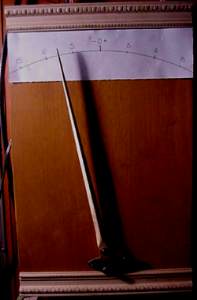
 The meter consists of a wooden back, a long wooden needle(14" long), which pivots on a nail. To the bottom of the long wooden needle is a surplus computer hard drive magnet glued on with super-glue. You can get the magnet out of most computer hard drives, or...we sell them, between $1 and $12, depending upon the scale of meter you have in mind. (it would be great to make a BIG one)
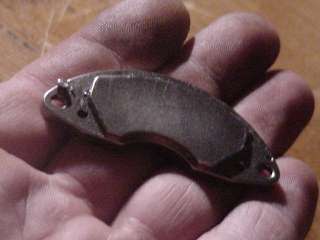 Pictured above is the surplus computer hard drive magnet. This is a NdFeB (Neodymium Iron Boron) rare earth magnet, the strongest permanant magnets currently developed. These are many times stronger than AlNiCo or ceramic magnets that we are all acustumed to, they make possible many new things! Without this magnet, this meter would not work nearly as well. The shape, strength, and polarization of these magnets make them perfect for a 0 centered ammeter. The steel back serves as a nice counterweight. Again, magnets similiar to these can be found inside almost any computer hard drive, or...if you like, go to our products page and you'll find several sizes available.
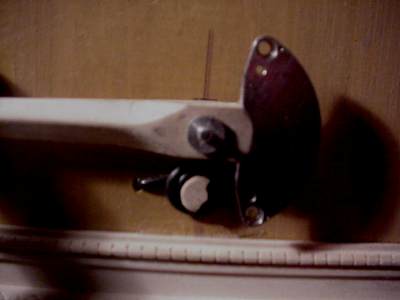
Behind the hard drive magnet (attached to the wooden back) is a wooden peg, around which is a coil (3 windings) of 12 gauge romex (normal copper wire for wiring houses). In the picture below, I swung the meter such that you can see detail of the magnet, the pivot, the bottom of the needle, and the coil of wire that drives it.
Pictured above is the surplus computer hard drive magnet. This is a NdFeB (Neodymium Iron Boron) rare earth magnet, the strongest permanant magnets currently developed. These are many times stronger than AlNiCo or ceramic magnets that we are all acustumed to, they make possible many new things! Without this magnet, this meter would not work nearly as well. The shape, strength, and polarization of these magnets make them perfect for a 0 centered ammeter. The steel back serves as a nice counterweight. Again, magnets similiar to these can be found inside almost any computer hard drive, or...if you like, go to our products page and you'll find several sizes available.
Behind the hard drive magnet (attached to the wooden back) is a wooden peg, around which is a coil (3 windings) of 12 gauge romex (normal copper wire for wiring houses). In the picture below, I swung the meter such that you can see detail of the magnet, the pivot, the bottom of the needle, and the coil of wire that drives it.
 There isn't much resistance, the meter works well because of the extremely strong rare earth magnet. More windings on the coil could make the meter more sensitive, less windings would make it less so. It can also be calibrated/centered with a small weight on the back of the magnet or the needle. I have mine set up to read +/-15 amps, this is appropriate for my power consumption/generation. The meter shown in the picture is somewhat inaccurate, as the scale should compress, especially near the ends of the scale. Mine is accurate between 0 and 10 amps, after that it becomes conservative. Simple thing, I think it can make for a more attractive meter for monitoring power systems than most available...at very little cost, if one has a couple hours to spend on it! As somebody who enjoys making/using my electricity, I also enjoy watching it come and go. This meter is sensitive, and moves freely enough that it responds very noticably to a small 12 volt car stereo, you can easily see it respond to music played at a reasonable level!